
- New
T2S C.A.R.E.S.: Before Capital Flows: Building Investment Readiness for Mental Health in Liberia
T2S C.A.R.E.S.
Headquarters: Atlanta, Georgia, United States
Project Country: Liberia
Keywords: mental health, universal health coverage (UHC), catalytic capital, investment readiness, health-system strengthening, implementation evidence, local ownership
Summary
Global health capital can finance a facility, training program, or technology. It cannot, by itself, guarantee that a local institution is ready to put that investment to work. T2S C.A.R.E.S. (Creating Access Responsibly for Everyone, Sustainably) is testing a different starting point in Liberia: establish the conditions for sustainable mental health delivery before scaling resources. Through its C.A.R.E.S. Model, the organization assessed five institutional settings, identified three conditional implementation anchors, and assigned distinct coordination and future-training roles to the others. This was not a service-expansion result; it was an evidence-based decision about where resources could work, what must be fixed first, and who must sustain them. The proposition for funders is straightforward: targeted readiness investments can create a stronger pathway from philanthropic or catalytic capital to functioning mental health infrastructure, measurable implementation, and ultimately more equitable access within UHC.
Key Figures
| 5 Institutional Settings Assessed in April 2026 |
3 Conditional Implementation Anchors Identified |
2 Additional Differentiated Institutional Roles |
Partner's Information
T2S C.A.R.E.S. is a U.S. based nonprofit advancing mental health as the first achievable priority within UHC. Through implementation science, workforce development, and cross-sector collaboration, we build and evaluate locally owned mental health infrastructure. Our long-term vision connects national implementation with continental training and knowledge hubs, creating pathways toward sustainable, measurable, and globally scalable health-system impact.
Background & Challenge
Mental health is significantly underfinanced worldwide: World Health Organization (WHO) estimates that over one billion people live with a mental health condition, while median government allocations to mental health remain around 2% of health budgets. But closing a funding gap is only part of the challenge. Local institutions must also be able to absorb, manage, and sustain what financing makes possible. Without protected space, stewardship, and operating procedures, new resources can become underutilized assets rather than lasting capacity. In Liberia, T2S C.A.R.E.S. asked a more demanding question before distributing proposed mental health learning resources: Which institutions were ready, which required targeted preparation, and which would contribute more effectively through governance or future training?
Approach
The C.A.R.E.S. Model treats implementation readiness as something to establish and verify before resource placement. In April 2026, T2S C.A.R.E.S. assessed five settings with local and visiting participants. The assessment considered place, people, package feasibility, and process: suitable facilities, accountable custodians, relevant resources, and workable systems for access, monitoring, and continuity. Structured findings were interpreted alongside on-the-ground observations, revealing that institutional enthusiasm did not always correspond to operational capability. Rather than assigning the same intervention everywhere, the team differentiated three institutional sites identified for activation once readiness conditions are met from national coordination and possible future-training roles. Each recommendation defined preconditions for authorization, physical protection, and stewardship. For funders, this creates a staged allocation logic: support the precise readiness work required at each site, verify milestones, and advance investment only as deployment conditions are established. The financing approach is deliberately flexible; early technical assistance or philanthropic capital may be appropriate before other financing mechanisms are considered.
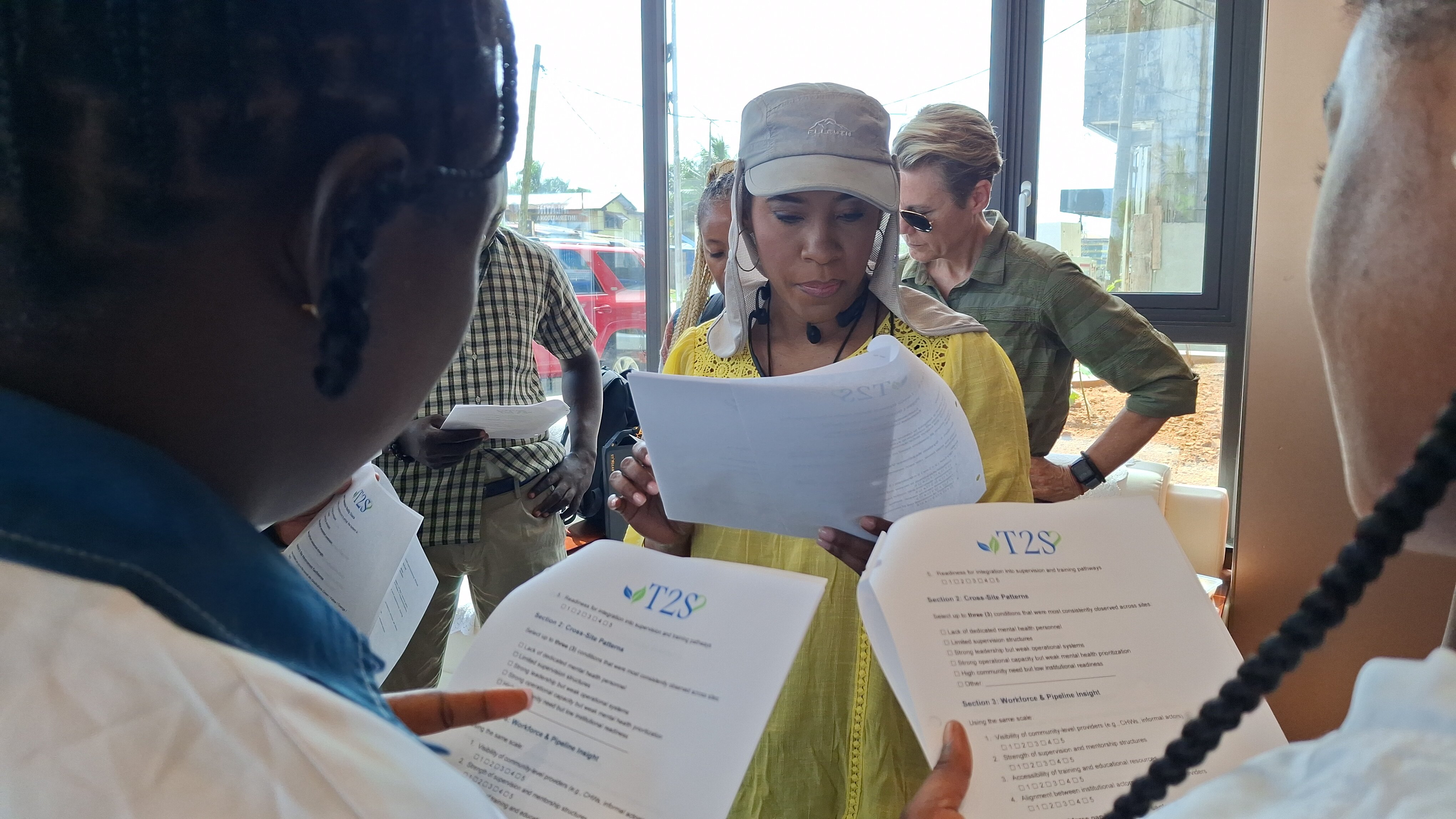
Collaborative review during Phase I of the T2S C.A.R.E.S. Liberia pilot, supporting locally informed decisions about institutional readiness and mental health infrastructure.
Impact & Results
Phase I assessed five institutional settings and identified three conditional implementation anchors, one governance/coordination function, and one potential future-training role. Recurring barriers-space, storage, authority, workforce, and continuity-became specific pre-activation requirements. Its immediate output is a more disciplined deployment plan, not a claim that three hubs are operating or that patient outcomes have already changed. This distinction is central to the case: measured readiness can inform where catalytic resources are likely to unlock functioning capability, where they should first correct a constraint, and where deployment should wait. Subsequent measurement will be necessary to establish utilization, service-access improvements, or population-level effects.
Future Outlook
Upcoming work will verify activation conditions, strengthen local stewardship, and measure resource use. T2S C.A.R.E.S. aims to build an evidence pathway from readiness to workforce capability, improved access, and eventually health outcomes. For capital partners, the opportunity is to make readiness support an explicit component of UHC financing rather than an afterthought.